Structured Course and Certification
I help experts turn their knowledge into structured certification or course programmes that are
clear, engaging, and ready to sell.
Project Title:
Menopause Doula Certification
Role:
Instructional Designer, Project Manager, Video Editor
Tools used in Development:
Google Docs, LXP Platform, Chatbase, Final Cut Pro, Canva, Nano Banana, Vizard, Turboscribe, InVideo AI, Chat GTP.
Time in Development: 20 weeks
Client: Menopause Doula Council

Executive Summary
This project addresses the need for trained non-medical support professionals to effectively support women through the menopause transition.
Despite menopause being a universal experience, gaps in awareness and professional training persist. Medical practitioners often receive limited education in menopause care, resulting in misdiagnoses, ineffective treatment, and women feeling unheard and unsupported.
The programme was designed to move beyond awareness-based learning and develop applied, client-facing competence, enabling professionals to deliver practical, evidence-informed support in real-world settings.
Challenge
Menopause is a universal experience for women, yet it remains widely misunderstood and under-supported. Despite its impact on physical and mental wellbeing, awareness and education around the menopause transition are limited for both women and professionals.
Research highlights significant gaps in both knowledge and support systems:
Over 50% of women feel uninformed about menopause before the age of 40
Many rely on informal sources such as media, friends, or magazines, which can lead to misinformation
Medical practitioners often receive little to no formal training in menopause care
A 2022 survey found that 72% of women reported medical advice as unhelpful or only somewhat helpful
At the same time, social stigma continues to shape negative perceptions of menopause, which has been linked to increased reporting of symptoms.
As a result of these gaps:
Women are unable to recognise or confidently interpret menopause-related symptoms
Women struggle to advocate for their needs or communicate effectively with healthcare providers
Non-medical support professionals lack the knowledge and tools to provide structured, reliable support
Even medical professionals may lack confidence in identifying and managing menopause-related concerns
This leaves many women feeling overwhelmed, unsupported, and unprepared for the transition. The reliance on inconsistent or inaccurate information, combined with ineffective professional support, contributes to increased distress and a reduced quality of life.
Addressing this challenge is complex due to the need to design learning that is both medically accurate and accessible to non-medical professionals. Additionally, stigma surrounding menopause can limit open discussion, while the diversity of symptoms and experiences makes it difficult to standardise support approaches.
Solution
Design Goal
To shift menopause support from knowledge-based awareness to applied, client-facing competence.
Because learners had varying levels of prior knowledge (medical vs non-medical), a spiral curriculum was implemented to revisit and deepen key concepts over time, reducing cognitive overload while building understanding progressively. Learners struggled to translate theory into practice, each module was structured into three layers:
medical and scientific foundations
practical application for doulas
tools and “practice pearls”
This ensured that knowledge was consistently linked to real-world use.
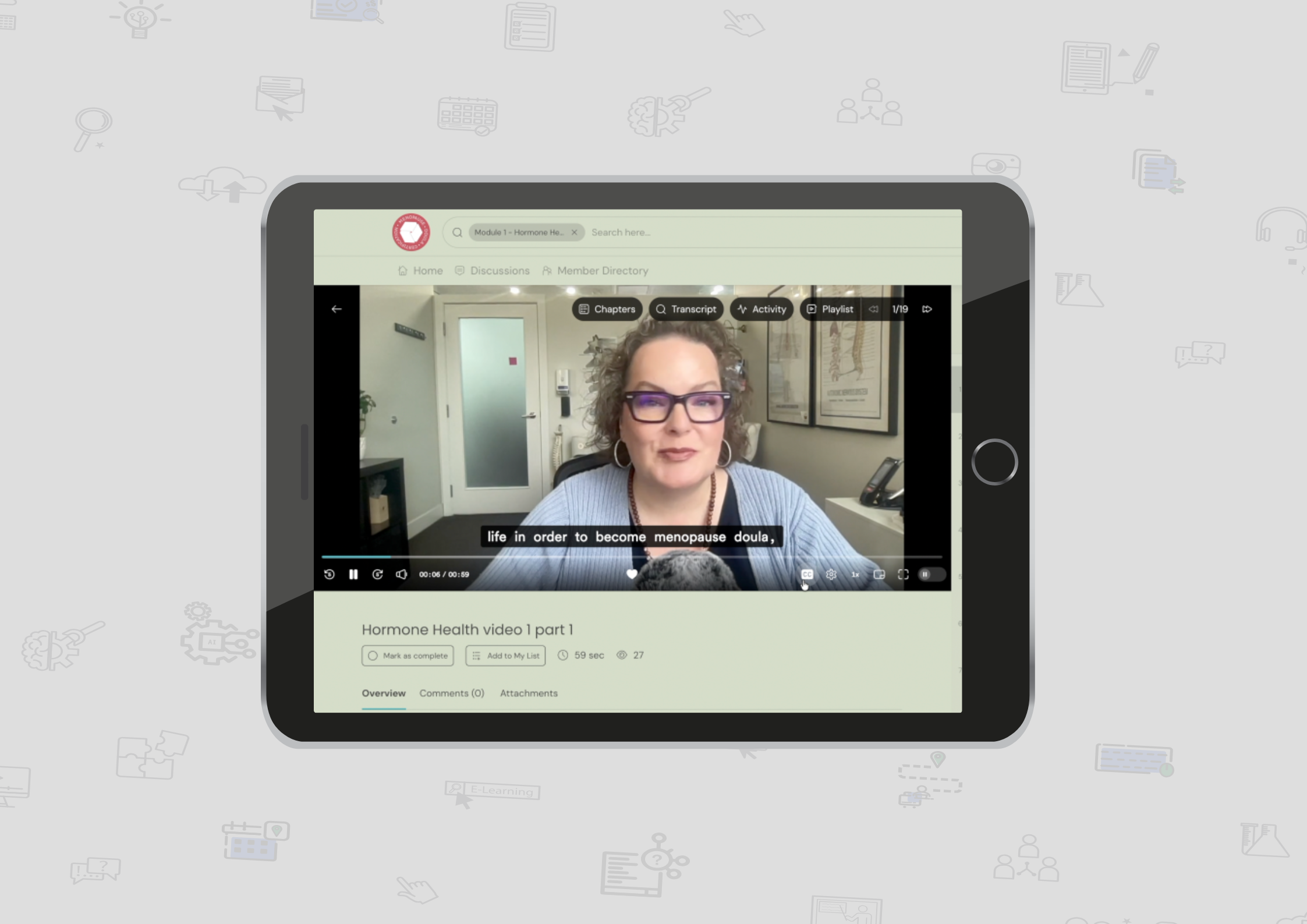
Because learners required flexibility and clarity, content was delivered through segmented video modules supported by guided workbooks, allowing learners to process information in manageable steps and apply it immediately.
The programme consists of eight modules delivered through a consistent structure combining video instruction, guided activities, and case-based learning. This provides predictability while reinforcing key concepts through repeated exposure and application.
Confidence in client interaction was a key performance gap therfore, learners were required to work with real clients, developing action plans and maintaining reflection logs over time. This ensured that learning extended beyond theory and was embedded in real-world practice.
Due to learners needing support during real interactions, not just during training, visual job aids, process models, and searchable transcripts were developed for quick reference. An AI chatbot was introduced to provide on-demand clarification and simulation-based practice, enabling learners to test responses and build confidence in a safe environment.
Because discussing menopause can be difficult due to stigma, a social learning space was introduced. This created a judgement-free environment for discussion, questions, and shared learning, helping build confidence and a sense of community.
Assessment was performance-based, requiring real-world client work, action planning, and reflection.
Results
The initial cohort achieved a 100% completion rate, with learner feedback highlighting the structure as manageable, well-balanced, and practical. The combination of video, workbook activities, and applied tasks was consistently identified as effective in supporting understanding and engagement.
Learners demonstrated increased ability to:
Identify and interpret menopause-related symptoms
Apply structured approaches to supporting clients
Use practical tools and frameworks in real-world interactions
Communicate more confidently and effectively about menopause
Medical professionals, in particular, reported increased confidence in recognising and supporting menopause-related concerns, while non-medical professionals were able to translate knowledge into actionable client support.
Women receiving support from trained professionals reported:
Greater confidence in understanding their symptoms
Improved ability to advocate for their needs
Increased use of non-medical support strategies
A stronger sense of being heard and supported
The integration of real-client application, performance support tools, and social learning contributed to early indicators of meaningful behaviour change. Learners were not only able to complete the programme but also apply their learning in real-world contexts, demonstrating practical competence rather than theoretical understanding alone.
This project reinforced the importance of designing for performance rather than knowledge alone. By focusing on what a menopause doula needs to do in practice, the programme became more relevant, actionable, and impactful.It also highlighted the value of combining structured learning, applied practice, and accessible support tools to drive both learner confidence and real-world outcomes.